
 The behavior landscape in schools has changed. About 80% of teachers report student behavior to be a serious issue, a number that has climbed steadily since the pandemic. This issue is even more pronounced for special education teachers, whose students are more likely to exhibit challenging behaviors. The effects of classroom disruptions often include loss of instructional time and an increase in burnout for educators.
The need for structured systems and strategies to support educators is more important than ever. There’s no overnight fix for behavioral challenges, but even incremental improvements in behavior can have significant effects on students and teachers. In this blog, we lay out 4 steps to building an effective behavior team that boosts positive student outcomes and supports the longevity of educators.
Teachers in the moderate/severe classroom can feel like they’re on an island, often facing additional challenges compared to their general education counterparts. Special educators need a practical roadmap to be successful instructing students with diverse learning and behavior needs. A successful framework is replicable and scalable, but flexible. You need enough structure so that everyone is on the same page, but enough “wiggle room” to respect the fact that every IEP is unique.
One of the most important parts of this step is getting everyone involved in the room. This includes teachers, therapists, behavior specialists, and anyone else that works closely with students receiving behavior supports. One study found that while behavior specialists often write the most technically accurate plans, it’s the classroom teachers who design the plans that actually work in the context of the day-to-day classroom environment. When you bring behavior specialists and classroom teams together, you get the best of both worlds: clinical accuracy and classroom reality. Plus, when people feel heard, they’re much more likely to buy in.
Not sure where to start? Check out this framework guide to begin mapping out your team’s approach.
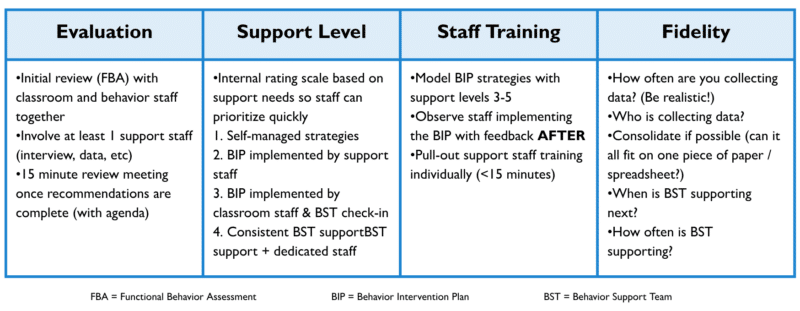
 Research tells us that behavior is the number one cause of burnout for special educators. And the first sign of that burnout is often a drop in fidelity, or how consistently we follow the behavior plan. To build capacity in your team without overwhelming, focus on these three things:
Just like our students, behavior teams thrive on consistency. Set a clear focus for every visit so teachers feel supported rather than evaluated. Using the rating scale from the table in Step 1 to determine how often the behavior support team observes specific classrooms (e.g., daily vs. bi-weekly). Schedule classroom visits and communications ahead of time to stay organized and prepared. Here’s an example of the cadence TeachTown uses in our Coaching Cohorts:

Behavior change is a marathon, not a sprint. When teachers feel equipped and supported by a team, a ripple effect occurs. As behavior stabilizes, research shows that time-on-task increases and academic outcomes improve. Additionally, behavior support systems can change teachers’ perceptions, ultimately helping them have a more positive outlook on teaching and reducing burnout. We may never see behaviors reduced to zero with our complex learners, but we can definitely see progress, and that progress can be life-changing.
 As your behavior team moves from planning to action, having a proven roadmap can make all the difference in ensuring long-term success. TeachTown’s Moderate to Severe Teaching & Learning Framework serves as that roadmap, providing special educators and administrators with tangible action steps for implementing best practices in classroom management and environment setup.
To truly drive student outcomes, this framework is best paired with enCORE, our K-12 standards-first, adapted core curriculum. By using the principles of Applied Behavior Analysis (ABA) and meeting students within their zone of proximal development, enCORE has been shown to help decrease challenging behaviors by as much as 42%. Together, these tools empower your behavior team to create a sustainable, engaging learning environment where both teachers and students can thrive.
This blog was adapted from our Virtual Summit session, Building Effective Behavior Support Teams by Dr. Ross Nesselrode – watch here!
Contributor Bios:
Ross Nesselrode is the Director of Customer Enablement at TeachTown. He is a Board Certified Behavior Analyst and former public school special education teacher and administrator. Ross holds a Ph.D. from the University of Texas at Austin, and his research includes how problem behavior is assessed in public school settings, as well as teacher feedback on assessment methodologies. Ross has publications in the following peer-reviewed journals: Behavior Analysis in Practice and Review Journal of Autism & Developmental Disorders.
Tasha McKinney brings over eight years of experience in education. After four years of teaching outdoor education programs, she received a Master’s in Early Childhood Special Education from the University of Texas. Since then, she has worked in classroom settings and created content for EdTech companies.